Two businesses spend the same €10,000.
One says Google Ads doesn’t work.
The other quietly hires more staff.
Same platform. Same auction. Different person behind the account.
Most business owners can’t tell the difference between someone who can launch campaigns and someone who can build a system that scales profitably, month after month.
This article is a hiring checklist for owners: where to search, the common mistakes, what to ask, what to verify, and how to choose the right Google Ads specialist without guessing.
Table of Contents
Why the right choice is important
This part sounds obvious to any owner. Wrong hire = wasted budget. Right hire = growth.
But in Google Ads the damage is sneaky. You don’t always see it in week one. You feel it later, when you look back and realize you paid for “activity”, not for business progress.
Let’s break it into two real risks.
Business performance waste risk
Google Ads is not a place where mistakes look like mistakes. They look like numbers. Clicks. Impressions. Conversions. Reports with green arrows.
That’s why a weak Google Ads specialist can sit in your account for months and still look “busy”.
1) Irrelevant traffic
In 2026 it’s almost impossible to get 100% perfect traffic. Google is broader. Match types are broader. PMax is a black box.
But there’s still a huge difference between 90% relevant and 70% relevant traffic.
A strong Google Ads specialist controls this through search term work, match type strategy, negatives, audience signals, and clean structure. A weak one accepts the waste as “normal traffic”.
2) Wrong tracking
I’ve seen accounts with years of history and hundreds of thousands spent where the data is basically useless because tracking was never set up properly.
And that’s painful because historical data is valuable. It helps you make better decisions faster.
But when tracking is wrong, you don’t “optimize”. You restart. From scratch.
3) Bad structure
Bad structure mixes everything together: brand with non brand, high intent with random, winning products with dead products.
So you open the dashboard and think “ROAS is good” or “CPA is fine”.
But when you dig deeper, most sales or leads come from:
- brand searches
- returning customers
- your loyal audience
In other words, the account looks healthy while new customer acquisition is weak.
4) Losing market share
Google Ads is a competitive auction. You’re “fighting” not only with Google. You’re competing with other businesses.
If demand is stable, then someone wins and someone loses. And the difference often comes down to small decisions made weekly: structure, bidding, tracking signals, search term control, landing page priorities, budget allocation. That winner or loser outcome is heavily influenced by who you hired.
Time waste risk
Money can be recovered. Time never is.
The biggest cost of hiring the wrong Google Ads specialist is not the first month of wasted spend.
It’s the months of delay while you think progress is happening.
1) You miss the window
Seasonality. Demand spikes. Product launches. Your strongest months.
Waste 6–8 weeks and you don’t get that window back.
2) You start adjusting the business around bad ads
You change offers. You lower expectations. You blame the market. You decide “Google Ads doesn’t work for us.”
But the problem wasn’t Google Ads. It was the person behind the account.
Then you hire someone new anyway
And the new specialist doesn’t start from “growth”. They start from cleanup: tracking, structure, search terms, negatives, bidding logic, reporting.
So you pay twice. And you lose time twice.
Common mistakes owners make
Finding a strong contractor is hard in any field. With Google Ads it’s even harder, because there is almost no barrier to entry.
You don’t need a degree. You don’t need a license. You don’t need permission from Google. Anyone can open an account, watch a few YouTube videos, call themselves a “Google Ads expert”, and start taking projects.
So owners end up hiring based on things that feel safe, but don’t actually protect them.
Below are the mistakes I see most often. Not to blame anyone, but to save you time and budget.
Hiring based on confidence
Owners often get sold on confidence. Big promises. Strong tone. Stories about “past wins” you can’t verify.

A real Google Ads expert won’t promise you a specific result like it’s guaranteed. Professionals don’t behave like that, because results depend on many variables: offer, pricing, margins, landing page, competition, tracking, sales process, seasonality.
That doesn’t mean a specialist should be vague. They should be clear about the process and what they can control.
But if someone is extremely confident about exact outcomes before they even audit your account, that’s a red flag.
Choosing the cheapest bidder
Cheap almost always means one of three things:
- template work (same structure copied to every client)
- outsourced work (you think you hired a senior, but the work is done by a junior)
- no process (random changes, no system, no documentation)
- no experience
Google Ads is not expensive because clicks are expensive. It becomes expensive when mistakes are expensive.
And cheap hires usually create expensive mistakes.
Choosing locals without deep research
A very common pattern: an owner types “Google Ads expert near me”, opens Google Maps, and picks someone local because it feels safer. “We can meet in person.”
The problem is that location tells you nothing about performance.
And what happens often is:
- you meet a nice agency owner
- you sign a contract
- the actual work is delegated to a freelancer with a low rate
Another issue is Google reviews. They can be useful, but they are not a real verification of Google Ads skill. In most cases, anyone can leave a review. Google doesn’t validate whether that person was an actual client, and it definitely doesn’t validate the results behind the review.
Local can be fine. But only if you vet them the same way you would vet anyone online: real proof, real process, real responsibility, real reviews that you can actually verify.
Hiring a “one person who does everything”
I see this all the time: the person who built the website also runs Google Ads. Or the person who helped with SEO also “can do PPC”.
That’s usually a mistake.
Google Ads is a deep skill. Tracking, structure, bidding strategy, search term control, creative testing, landing page feedback, reporting. It’s not a side task.
If you want results from Google Ads, hire a specialist who does Google Ads as their main job. Not someone who “can also set it up”.
Why I Recommend Upwork for Hiring a Google Ads Specialist
You can find a Google Ads specialist in many places. Google search, agencies, LinkedIn, referrals. But if your goal is to hire based on proof, Upwork is one of the best options.
Not because every freelancer there is great. They’re not.
But because the platform gives you more signals to filter out weak candidates before you waste time.
Real projects and reviews
On Upwork you’re not reading “testimonials” written on someone’s own website. You’re seeing a work history connected to real contracts.
You can check:
- how long the freelancer has been active
- how many projects they completed
- whether clients come back for more work
- what clients actually say after the project is finished
It’s not perfect, but it’s much harder to fake than a random review on Google Maps or a screenshot in a PDF.
You’re protected
Upwork is built to protect both sides, and that helps you as an owner.
A freelancer doesn’t want disputes, doesn’t want refunds, and definitely doesn’t want a bad public review that stays on the profile forever. That pressure alone makes most serious specialists more disciplined than someone you pay directly with no platform in the middle.
Also, payments and milestones are structured. You’re not sending money “on trust”. You control the process.
Huge choice of Google Ads specialists
Upwork gives you the biggest advantage that local search can’t: options.
You can choose by:
- location (if it matters to you)
- hourly rate or fixed price
- niche experience (ecommerce, lead gen, SaaS, local services)
- budget level (someone used to managing $500 is not the same as someone managing $50,000)
- communication style (important for long term work)
And after you shortlist 3–5 profiles, you can run the same interview questions and compare them side by side.
How to choose a Google Ads manager on Upwork
Knowing where to hire is good. But it’s not enough. Upwork has a lot of options, and if you don’t know what to look for, it’s easy to hire someone who can talk about Google Ads but can’t actually run it at a high level.
In this section I’ll show you what to check inside the platform so you can filter fast and choose a real Google Ads specialist.
I’ll use screenshots from my own Upwork profile to show what “proof” looks like in practice. If you want to open it and follow along: Yulian Hrab on Upwork.
Profile signals that matter
Think of this as the first filter. You’re not looking for “a nice profile”. You’re looking for signals of focus, experience, and accountability.
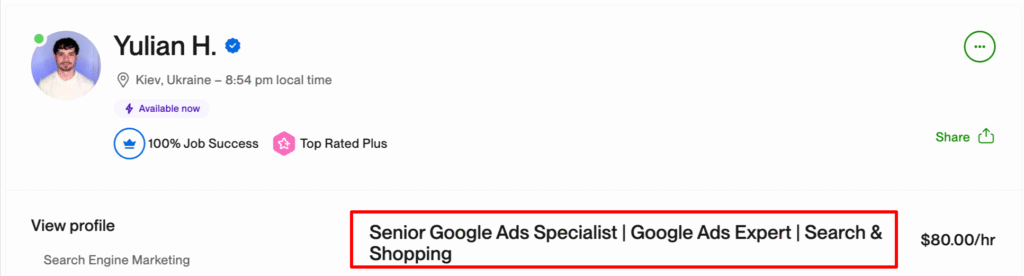
Clear positioning (what they do)
Look for specialists who are focused. Ideally, the profile is clearly about PPC marketing, with a strong focus on Google Ads management.
If someone offers everything: PPC, SEO, web design, branding, social media, email marketing, Shopify setup, “AI automation”… that’s usually not a Google Ads expert. That’s a generalist.
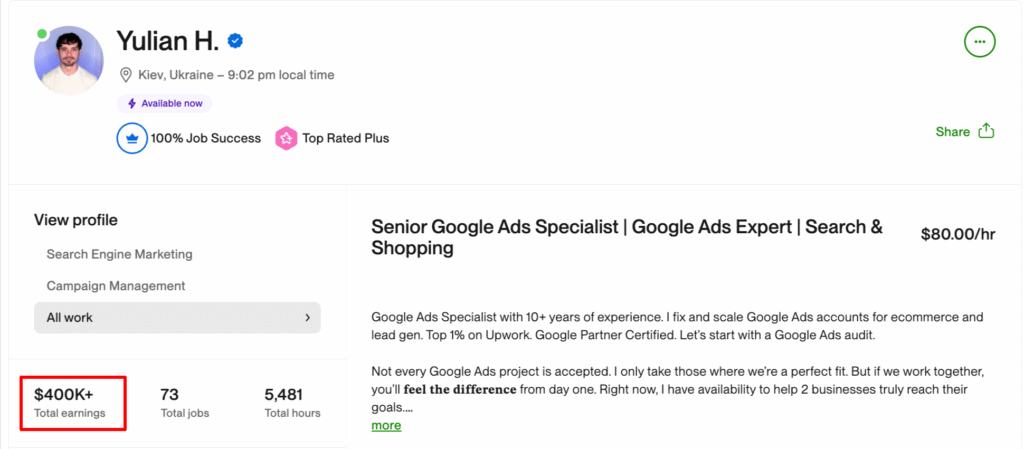
Total earnings on Upwork
Total earned is one of the fastest signals to read on Upwork because it shows real traction on the platform. If a freelancer has earned meaningful money there, it usually means they’ve worked with real clients repeatedly and delivered well enough to keep getting hired.
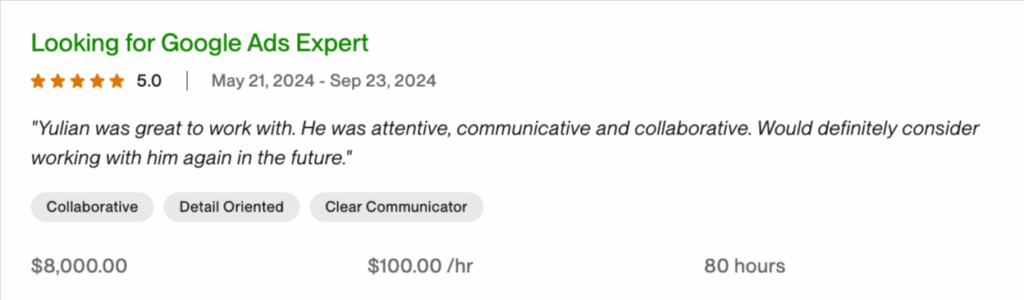
Reviews
It’s important to look not only at the 5-star rating, but at what clients write in the review. The text tells you much more about the real quality of the work. If people don’t sound generic, mention specific results, specific improvements, or describe the freelancer’s approach and attitude, it usually means Google Ads specialist genuinely exceeded expectations.
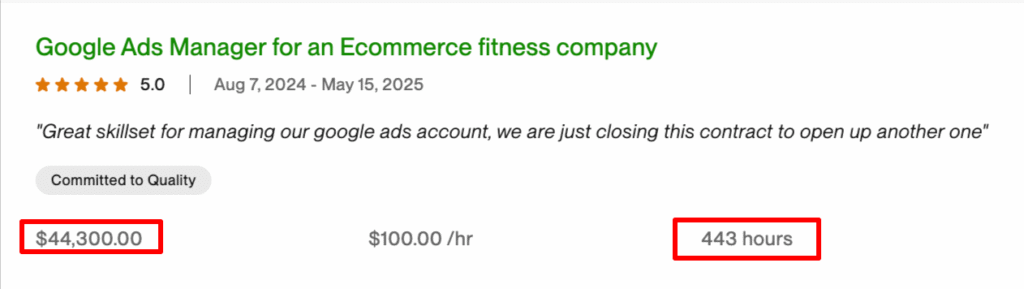
Projects
If you’re ecommerce, you want to see ecommerce Google Ads projects. If you’re lead gen, you want lead gen projects.
Ideally:
- similar business model
- similar budget range
- long term projects (not just one week “setup” jobs)
- strong reviews attached to those projects
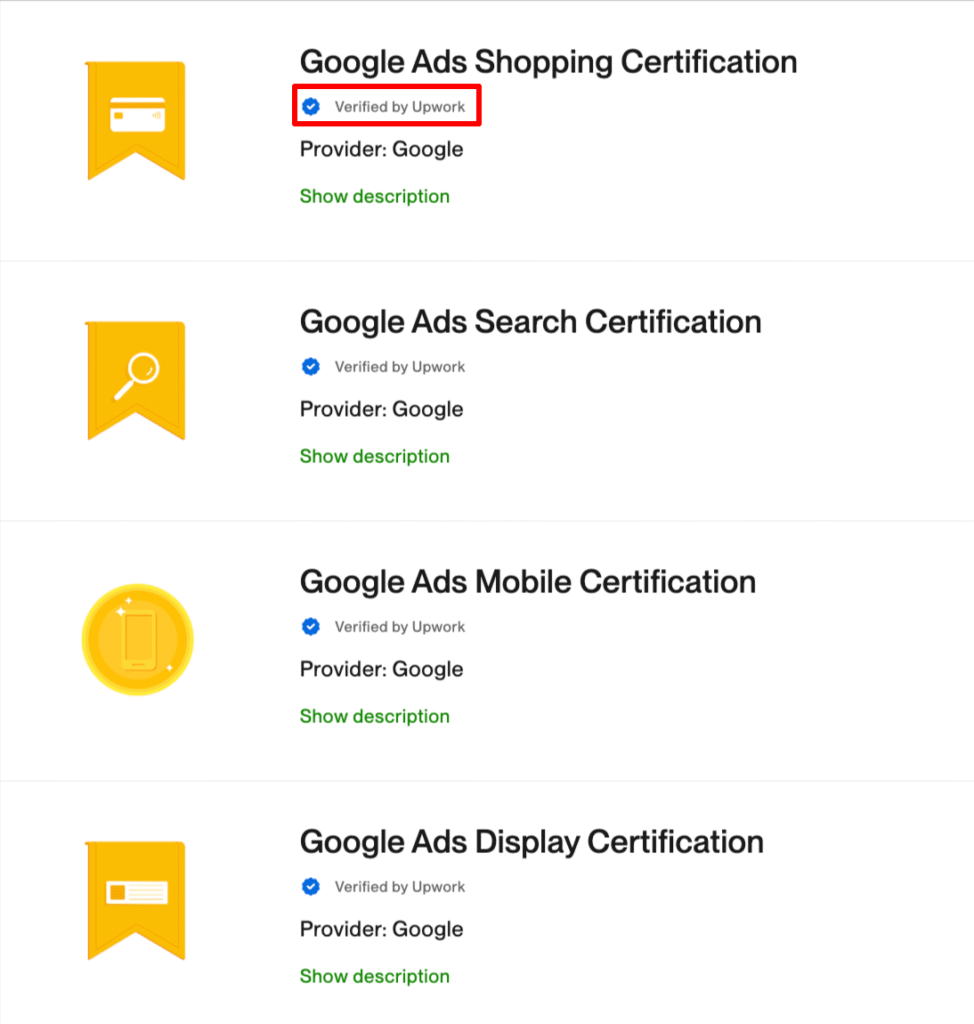
Certifications (verified)
Google Ads certifications are not magic, but they are still a positive signal.
On Upwork, the best case is when certifications are verified (not just “I am certified” written in text). Treat certifications as a bonus, not as your main hiring criteria.
Video (optional, but useful)
A video isn’t required, but it’s a strong plus when you’re trying to choose a Google advertising expert.
You quickly understand:
- how the person communicates
- whether they sound structured or chaotic
- if they look like the person who will actually do the work
If there’s no video, it’s fine. But if there is one, it’s often a good sign.
What to check after you shortlist candidates
Shortlisting profiles is only step one. The final decision happens when you speak to the person and see how they think. At this stage you’re not looking for “a nice talk”. You’re looking for signals of competence, honesty, and a clear process.
The call
A good Google advertising manager will ask questions about your business. Not because they want to sound smart, but because they need context to make the right decisions: margins, LTV, capacity, seasonality, your strongest products/services, sales process, and what a “good lead” actually means.
If the call feels like a sales script from start to finish, that’s a bad sign. You will feel it. Real Google Ads specialists don’t rush to promise results. They try to understand the situation first, and they’re usually direct about what they can and can’t do.
Also pay attention to honesty. If you ask a hard question and they dodge it, overpromise, or answer in vague marketing language, you’re probably not talking to a real expert.
The Google Ads audit
If you already run Google Ads, an audit is the next logical step to choose the right specialist.
But an audit must be clear and objective. If you receive a confusing spreadsheet with a random checklist of settings, that’s not an audit. That’s a template.
A real audit should be easy for an owner to understand. It should show:
- what is broken or wasting budget, d why
- what is limiting growth, and why
- what to fix first, what to fix later
- a concrete action plan for the next 4–8 weeks
If the audit feels like a vague document designed to scare you into signing, treat it as a sales trick. A real audit gives you clarity, not confusion.
Questions to ask Google Ads specialists
At this stage you probably have 2–5 candidates who all look good on paper. That’s normal. The difference is usually not in the profile, but in how they think and how they work week to week. The goal of these questions is to make the conversation concrete.
1) Do you personally do the work, or will someone else run my account?
This is the fastest way to catch outsourcing. You want a clear answer. If they mention a “team” or “assistants”, ask who exactly touches the account, and who is responsible for decisions.
2) Do you handle conversion tracking, or do you require my developer to do it?
A serious Google Ads specialist understands tracking. They should be able to audit your current setup, explain what’s missing, and coordinate fixes. If they ignore tracking or treat it as “not my job”, you’re buying guesses.
3) How do you report: what metrics, how often, and what decisions come from the report?
You don’t need pretty charts. You need decisions. Ask what Google Ads Specialist send weekly, what they review monthly, and how they explain performance in simple business terms (not only CPC and CTR).
4) What is your weekly workflow, exactly?
A real Google Ads expert has a routine: search terms, negatives, budget shifts, bid strategy checks, creative testing, landing page notes, tracking validation. If the answer is vague like “I optimize daily”, that’s not a workflow. That’s a slogan.
Conclusion
Google Ads can work very well for most businesses. But it only works when the account is managed like a system, not like a set of random campaigns.
If you remember one thing from this guide, let it be this: don’t hire based on confidence, titles, or “nice promises”. Hire based on proof, clarity, and ownership. Check the profile signals, shortlist a few candidates, ask the right questions, and make sure the person can explain their process in a way that makes sense for you as an owner.
If you want to discuss your project and get an honest opinion on what’s realistic in your situation, you can reach out here: LINK.
I manage accounts myself, not “my team”. If I see a clear path to improve your results, I’ll tell you. If I don’t, I’ll also tell you.