If you’re a dental clinic owner, you don’t care about CTR. You care about chairs filled with the right cases at the right price. This guide is built for that.
Table of Contents
- Google Ads for Dentists in 2026
- Google Ads for a Dental Clinic: The Only Numbers That Matter
- Dental Google Ads Budget Strategy
- Dental Patient Psychology
- Tracking That Doesn’t Lie
- Google Ads for Dentists Account Structure
- Dental Google Ads Strategy by Service
- Local Services Ads vs Google Ads for Dentists
- 90-Day Dental Google Ads Optimization Plan
- Choosing a Google Ads Agency for Dentists
- FAQ: Google Ads for Dentists (2026)
Google Ads for Dentists in 2026
If you’ve been running Google Ads for dentists for a while, 2026 feels like this weird mix of “everything changed” and “nothing changed.”
Yes, Search looks different. People skim AI summaries. They click fewer blue links. Google pushes more automation.
But the core truth for any Google Ads for a dental clinic is still the same:
Patients don’t want marketing. They want a clear next step. Call. Book. Show up. Get help.
So your job in 2026 is not to “game the algorithm.” It’s to build a system that matches how people decide by service type, and makes booking frictionless.
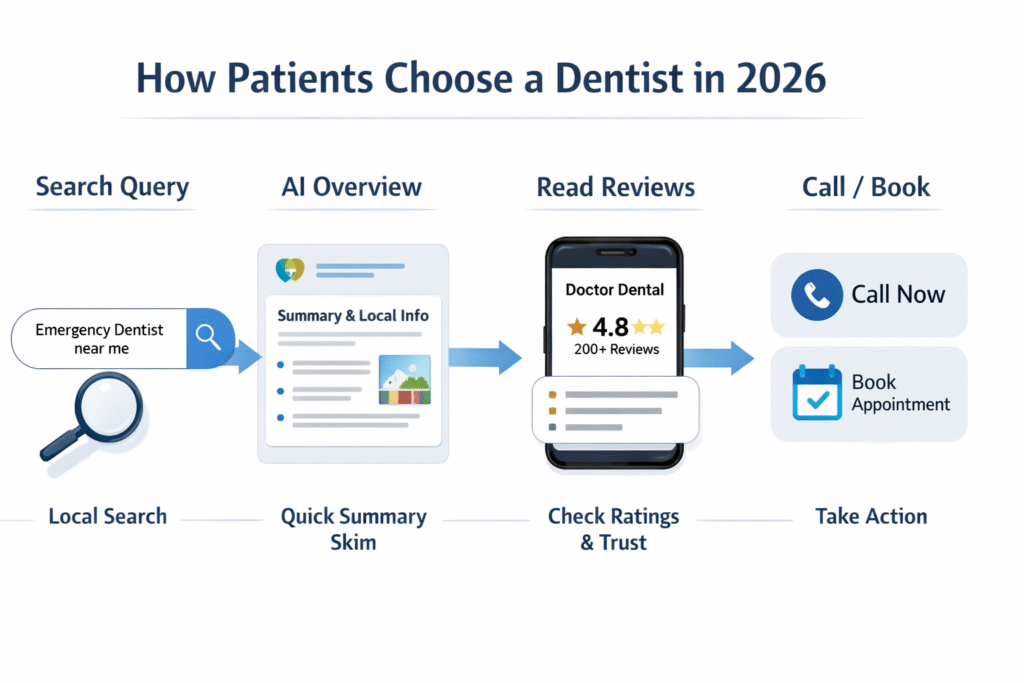
AI Overviews, local intent, and why Search still wins for dental clinics
AI Overviews and AI Mode can use something Google calls query fan-out. In plain English: one question turns into many related searches behind the scenes. Google then pulls a wider set of supporting pages into the answer.
What that means for dental Google Ads is simple:
People will still search “emergency dentist near me” and “Invisalign cost [city]”
But they’ll also silently evaluate sub-questions like:
- Are they trusted
- Do they have good reviews
- Can I get in today
- What will it cost roughly
- Is this clinic legit
- What happens next
Search still wins because dental is local, high-intent, and time-sensitive. When someone has tooth pain, they don’t want a brand story. They want a phone number that gets answered.
So in 2026, you win Search by doing three things better than everyone else:
Make it obvious you’re local and real
Your ads and landing pages should scream: location, hours, reviews, real photos, real doctor.
Answer the “sub-questions” fast
Not with essays. With clean blocks: pricing ranges (if you can), insurance clarity, “what happens next,” pain/anxiety reassurance, financing, and proof.
Match intent by service
Emergency is not veneers. Kids dentistry is not implants. Different patient brain. Different ad angle. Different funnel.
AI Max for Search campaigns: where it helps and where it wastes money
AI Max for Search campaigns: where it helps and where it wastes money
AI Max is not magic. It’s a set of features inside Search that can:
- improve how ads match search terms
- optimize ad content
- and use Final URL Expansion (sending people to a more relevant page on your site)
That last part is the big deal for dentists.
If you run multiple services (emergency, Invisalign, implants, veneers), Final URL Expansion can help Google send traffic to the most relevant page instead of forcing everything through one URL.
Where AI Max helps a dental clinic
- You have strong service pages (one service, one page, one CTA).
- Your tracking is clean and you’re optimizing to booked appointments, not junk leads.
- You want controlled expansion beyond your tiny keyword list.
Demand Gen and when a dental clinic should actually use it
Start with Search because it captures existing intent. Demand Gen is what you layer in when:
- Your Search campaigns are already profitable and tracked correctly.
- You want to grow premium services that require consideration (implants, Invisalign, veneers).
- You have real creative assets (not stock photos and generic copy).
- You can follow up properly (because these leads often need nurture).
When Demand Gen makes sense for dentists
- You’re pushing a premium offer with strong proof (cases, reviews, doctor credibility).
- You’re in a competitive city where Search is expensive and you need extra pipeline.
- You’re multi-location and want scale beyond pure “near me” intent.
Google Ads for a Dental Clinic: The Only Numbers That Matter (Owner Math)
Most Google Ads reports are built to look busy, not to tell the truth.
A dental clinic doesn’t live or die by CTR. It lives or dies by one thing:
How much it costs you to put the right patient in the chair.
The only “ROI formula” you need
You want to know your maximum cost per booked appointment before you scale.
Here’s the simple version:
Max cost per booked = Average profit per case × (Show rate × Acceptance rate)
Example (easy numbers):
- Profit per Invisalign case: $2,500
- Show rate: 70%
- Acceptance rate: 40%
Max cost per booked = 2,500 × (0.7 × 0.4) = 2,500 × 0.28 = $700
So if you’re paying $350 per booked consult, you’re fine.
The metric that exposes bad Dental Google Ads agencies fast
Ask one question:
“What is our cost per booked appointment, by service?”
If they can’t answer that confidently, you’re not buying strategy.
Dental Google Ads Budget Strategy Based on Chair Availability
Your budget shouldn’t be based on what you “want to grow.”
It should be based on how many chairs you can actually fill.
That’s why the best dental Google Ads accounts don’t run one “always on” strategy. They change gears depending on availability.
If you remember one thing from this section, remember this:
When you’re almost full, advertise expensive services.
When you’re underbooked, advertise speed.
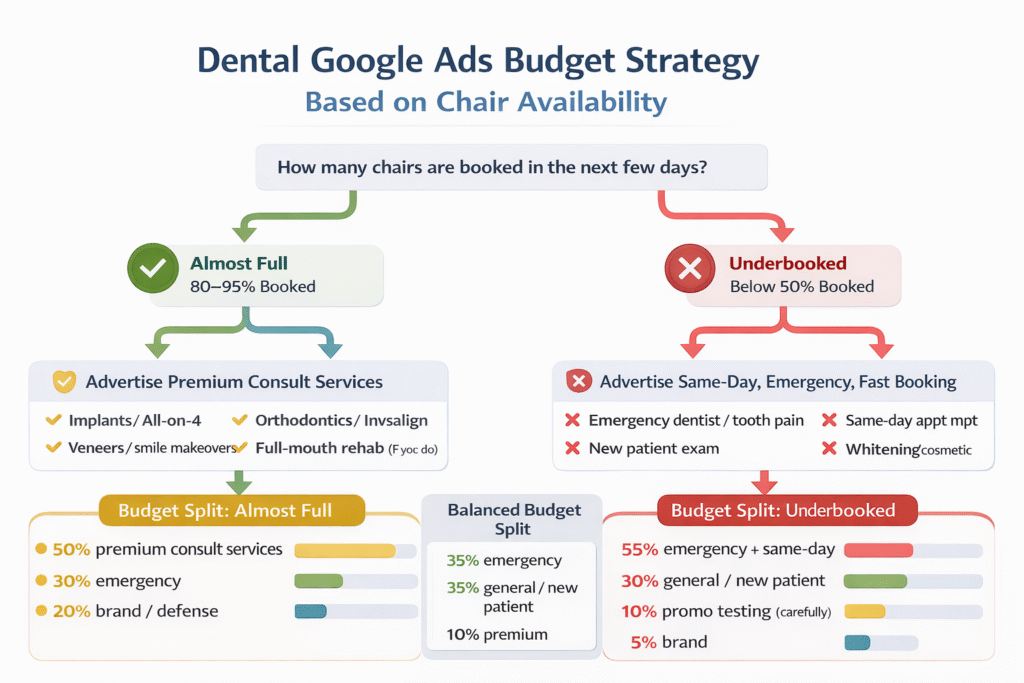
If you’re almost full: advertise your most expensive services
If your schedule is 80–95% booked, your goal is not “more patients.” Your goal is better patients.
You’re protecting margin and keeping a pipeline for cases that actually move revenue.
If availability is bad: advertise same-day, emergency, fast booking
If you’re underbooked, you don’t need “branding.” You need action.
This is when Google Ads for a dental clinic should be built around speed and certainty.
Best services to promote when you’re underbooked
- Emergency dentist / tooth pain
- Same-day appointments
- New patient exam
- Hygiene (if you have capacity)
- Simple cosmetic wins (whitening) if it performs in your market
Dental Patient Psychology: How People Choose a Dentist (By Service Type)
A patient looking for an emergency dentist is not “shopping.”
They’re panicking, they’re in pain, and they want certainty.
A patient looking for veneers is doing the opposite. They’re imagining a future version of themselves. They want proof, taste, and confidence that they won’t regret it.
This section gives you a simple way to think about patient decisions, and how to translate that into Google Ads for dentists.
The 5 decision drivers (trust, risk, convenience, fairness, human connection)
These five drivers show up in almost every dental decision. The difference is which one is dominant by service.
1. Trust (proof)
People don’t want “best dentist.” They want signals.
Reviews, rating, years in practice, real photos, recognizable credentials.
2. Risk reduction (fear of pain, fear of being judged, fear of wasting money)
Dental anxiety is real. Also “money anxiety” is real.
Patients want to feel safe before they commit.
3. Convenience (speed, proximity, hours, booking)
This is the silent killer. You can have the best clinic in town, but if booking feels hard, they bounce.
4. Fair pricing (not cheap, fair)
Most people don’t want the cheapest dentist. They want to avoid getting ripped off.
5. Human connection (confidence + empathy)
This is why clinics with normal offers and great staff win. Patients want to feel respected and understood.
Tracking That Doesn’t Lie:
If you only track calls and forms, Google will do exactly what you told it to do.
It will find you more calls and more forms.
Not more patients.
That’s why so many dental clinics say “Google Ads doesn’t work” while the account shows “great” conversion numbers. Those conversions are often just activity. Not outcomes.
For Google Ads for dentists to scale in 2026, your tracking has to follow the real business path:
Click → Lead → Booked → Showed → Treatment accepted → Revenue
Once you track that, optimization becomes obvious.
Minimum tracking stack for PPC marketing for dentists
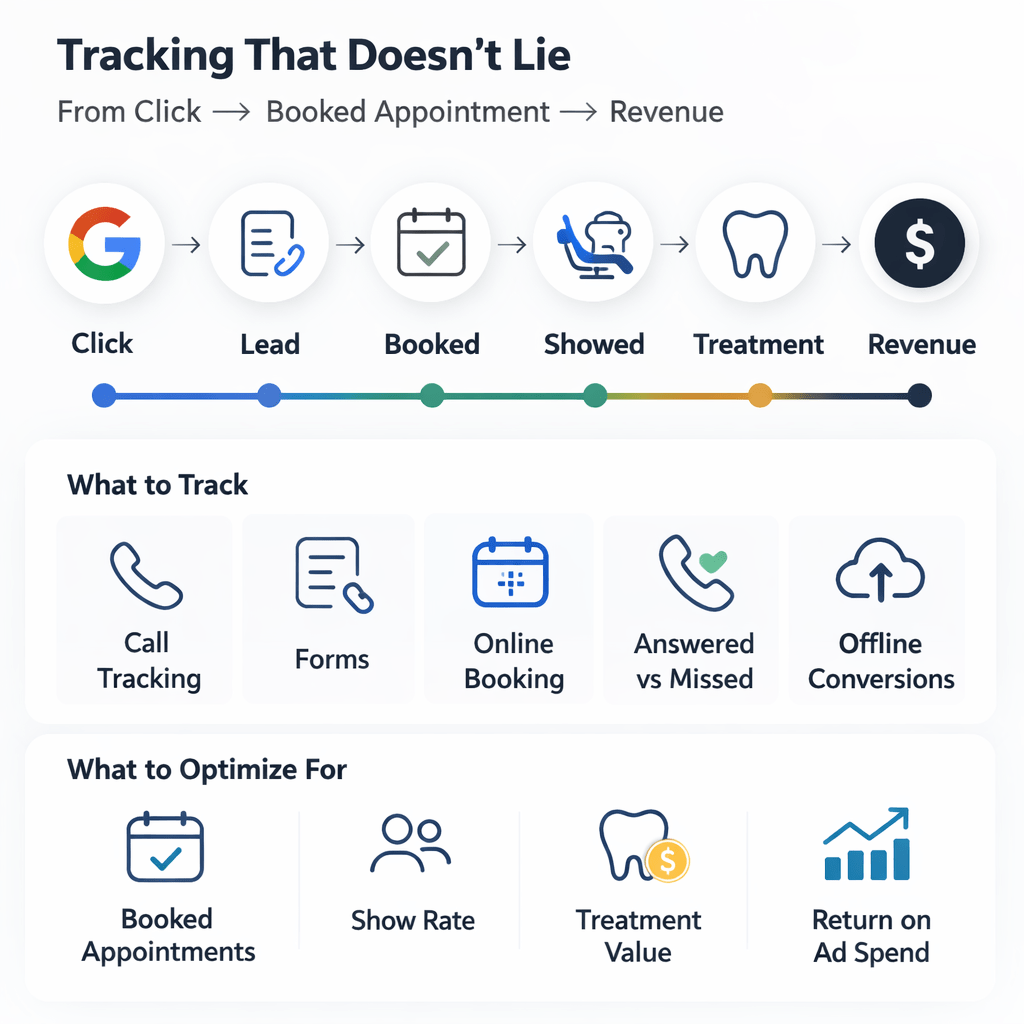
Here’s the minimum setup I’d want before spending serious budget on dental Google Ads:
- Call tracking you can trust
- Website call conversions (from your site)
- Call assets (from ads)
- A way to measure answered vs missed calls (because missed calls are paid leaks)
- Form tracking
- Basic form submit conversion
- Ideally a “qualified lead” version too (if you can label leads in CRM)
- Online booking tracking (if you use it)
If patients can book without calling, track that separately. It behaves differently than calls. - Booked appointment conversion
This is the big one. “Booked” is the moment the lead becomes real.
If you don’t track booked, your bidding strategy will optimize for the wrong thing.
Enhanced conversions for leads + offline imports (booked/showed/value)
This is how you move from “marketing tracking” to “business tracking.”
Step 1: Import offline conversions
Upload what happens after the click:
- Booked appointment
- Showed appointment
- High-value procedures started (implants, Invisalign, etc.)
Step 2: Upgrade to Enhanced conversions for leads
Google recommends Enhanced conversions for leads as the modern way to improve attribution and performance for offline outcomes.
In simple terms: it helps Google match leads back to ad interactions more reliably, which improves optimization when cookies and tracking are imperfect.
Google Ads for Dentists Account Structure
Most “dental Google Ads” accounts fail because they’re built like a bucket. Everything goes in, and you hope it works.
A good structure is the opposite: separate intent, separate budgets, separate landing pages. That’s how you control quality and scale without chaos.
Keep it simple and strict:
- Brand
Protect your name. Cheap clicks. High close rate. Also stops competitors from stealing easy patients. - Emergency
Call-first. Tight radius. Open hours only. This campaign lives or dies by speed. - General dentistry / new patient
Booking-first. Strong proof. Tight negatives so you don’t buy junk traffic. - Premium services (separate campaigns)
Implants, Invisalign/ortho, veneers. Each has different psychology and different economics, so each needs its own campaign.
Keyword strategy in 2026 (control group + expansion with guardrails)
Do this:
- Build an Exact/Phrase “control group” for your core money terms.
- Add expansion carefully (broad/AI Max) only after:
- negatives are solid
- tracking is tied to booked/showed
- landing pages match the service
Rule: expand last, not first.
The negative keyword firewall (waste spend prevention)
Your negatives aren’t a list. They’re a system.
Start with buckets:
- jobs, salary, school, course
- free, cheap (depends on your positioning)
- DIY, home remedy
- insurance terms you don’t accept
- irrelevant services you don’t provide
Dental Google Ads Strategy by Service
When a new dental clinic comes onboard at Excella PPC, the first thing I ask on the kickoff call is simple:
“What services do you want to promote?”
And most owners do the same thing. They list everything.
General dentistry. Emergency. Invisalign. Implants. Veneers. Kids. Whitening. Night guards. You name it.
And that’s the moment I usually say no.
We need to decide based on availability and budget. Because each dental service require concrete Google Ads approach.
Emergency Dentist Ads
These people are not comparing brands. They’re choosing whoever feels fast, close, and trustworthy.
The psychology (what matters most)
- Convenience: can you see me today
- Risk reduction: will it hurt, will I get judged, will I get ripped off
- Trust proof: reviews, rating, “real clinic” signals
So your ads should lead with speed, then calm them down.
Targeting rules (how you stop buying garbage)
- Tight radius first (closer = higher show + lower cancellations)
- Exclude areas you know won’t convert
- Schedule ads around open hours unless you have real after-hours handling
- Heavy negative keyword system (jobs, school, free, DIY, etc.)
Implants
Implants are the opposite of emergency.
People are not panicking. They are cautious. The fear is different:
- fear of making a costly mistake
- fear of pain and complications
- fear of being sold to
So your ads have one job:
Make them feel safe enough to book a consultation.
Funnel (consult-first)
Landing page rules:
- Proof above the fold (reviews + credentials + cases)
- A clear “who it’s for / not for” block (filters junk)
- Process timeline: consult → scan → plan → treatment
- Financing explanation
- FAQ that answers cost, pain, timeline, recovery
Orthodontics / Invisalign
Invisalign and ortho ads don’t win by being loud. They win by making the decision feel easy.
People want the result. They also want to know three things fast:
- Am I a candidate
- How long will it take
- Can I afford it
Funnel (consult-first, but faster than implants)
Landing page rules:
- “Am I a candidate?” section above the fold
- Timeline + what happens at consult
- Financing / monthly payments explanation
- Before/after (if you have real cases)
- Strong reviews
Veneers / Cosmetic
Cosmetic is where clinics waste money on curiosity clicks.
People love looking at veneers.
Fewer people are ready to book.
So your job is to attract the right intent and filter the rest.
Offer
- “Smile makeover consultation”
- “Veneers assessment”
- “Custom plan + options explained”
- Financing mention if available
Avoid anything that feels like Groupon.
Kids / Pediatric
Parents don’t want “marketing.” They want safety and a smooth appointment.
Pediatric ads should feel calm, local, and credible.
Landing page rules:
- Parent reviews and clinic photos
- “First visit” explained
- Short FAQ for parents
- Clear booking CTA
Local Services Ads vs Google Ads for Dentists (Search): what to run and when
The best play: use both, but split roles
If I’m running dental google ads properly, this is a common structure:
- LSAs → capture “I need someone now” demand (simple local intent)
- Search Ads → control everything else:
- emergency campaign (call-first, open hours)
- general/new patient (booking-first)
- premium services (consult-first + proof)
This setup does two things:
- It protects Search from getting flooded by low-quality “near me” volume
- It lets you scale premium services without LSAs limiting you
Common LSA mistakes that waste money
- Running LSAs while missing calls (you pay for visibility you can’t convert)
- Treating every lead as equal (some are spam, some are wrong service)
- Not aligning LSAs with availability (same rule as Search: capacity first)
Budget starting point (simple)
- Underbooked: LSAs 30–50%, Search 50–70%
- Balanced: LSAs 10–30%, Search 70–90%
- Almost full: LSAs minimal or off, Search focused on premium consult services
90-Day Dental Google Ads Optimization Plan
Most clinics either “set and forget” their dental Google Ads… or they panic and change everything every week.
Both lose.
The right way is simple: first stop waste, then lift conversion rate, then scale winners.
90 days is enough to build a stable machine if you follow a system.
Weeks 1–2: Stop wasting budget (clean up the leaks)
Your goal in the first two weeks is not growth. It’s control.
1) Search terms + negatives
- Pull search terms daily at first.
- Add negatives in buckets (jobs, school, free, DIY, irrelevant services).
- Kill obvious waste fast.
2) Location leakage
- Check where leads are coming from.
- Exclude areas that don’t show or don’t convert.
- Tighten radius for emergency if needed.
3) Schedule cleanup
- Run ads when you can answer and book.
- If you can’t handle after-hours, don’t buy after-hours calls.
4) Intake audit (this matters more than bids)
- How many calls are missed?
- How fast do you call back?
- Are leads being booked or “handled”?
Goal by end of Week 2: waste down, lead quality up, and your front desk process visible.
Weeks 3–6: Lift conversion rate (turn traffic into booked appointments)
Now you start making the same traffic produce more booked patients.
1) Landing page fixes (service-specific)
- Emergency = call-first page (phone, hours, location, reviews above the fold)
- Premium services = consult-first page (proof, process, FAQs, financing)
2) Offer clarity
- Remove bait offers.
- Make the next step obvious.
- Add “what happens next” in 3 steps.
3) Ad copy tuning by service
- Emergency = speed + certainty + trust
- Implants = trust + risk reduction + process
- Invisalign = outcome + payments + candidacy
- Kids = safety + trust + convenience
- General = convenience + reviews + clarity
4) Conversion tracking upgrade
- Separate conversions by type (calls vs forms vs booking).
- If possible, start importing booked appointments.
Goal by end of Week 6: conversion rate higher, booked appointments more consistent, less junk.
Weeks 7–12: Scale winners safely
Now you stop guessing and start scaling what is proven.
1) Budget reallocation
- Move budget to campaigns that produce booked appointments with good show rates.
- Cut the campaigns that look “busy” but don’t create patients.
2) Bidding upgrades
- Only switch to stronger automation when your conversion data is clean.
- If you test broader matching/AI expansion, isolate it in a separate campaign.
3) Expand intentionally
- Slightly widen geo for premium services if proof is strong.
- Add new service campaigns one at a time (don’t launch 6 at once).
4) Turn reporting into a clinic dashboard
Track weekly:
- cost per booked appointment (by service)
- show rate
- acceptance rate (if you can)
- revenue or estimated value
Goal by end of Week 12: stable acquisition machine that you can scale or throttle based on availability.
Choosing a Google Ads Agency for Dentists
Dentistry isn’t “special” in the sense that it needs magical dental secrets.
What is special is that google ads for dentists has its own realities: local intent, phone calls, emergency demand, service-by-service funnels, and a lot of wasted spend if the account isn’t structured right.
So the selection process is normal. You just want an agency that actually understands google ads for a dental clinic and can prove it.
You don’t need a “dental advertising agency” that promises magic.
You need a Google Ads team that runs a disciplined process and has done it for clinics before.
If you want the full checklist, we already wrote a separate guide on the universal part of this decision:
How to Find a Google Ads Agency Founder Checklist
FAQ: Google Ads for Dentists (2026)
How much should a dental clinic spend on Google Ads in 2026?
Your budget depends on your location and services. But also, spend should follow chair availability, not ego. If you’re underbooked, you can scale emergency/new patient faster. If you’re almost full, shift budget to premium consult services and filter harder. A small budget that can’t generate enough conversions often fails because Google can’t learn.
What’s a good cost per booked appointment?
A “good” cost is whatever keeps you profitable based on your math. If your average profit per case is high (implants, Invisalign), your acceptable cost per booked consult can be much higher than general dentistry. The right answer comes from your break-even model, not from internet benchmarks.
Do I need a new landing page for every service?
If you want top performance, yes. Emergency traffic behaves differently than veneers traffic. One service → one page → one primary CTA. Otherwise your conversion rate drops and lead quality gets worse.
How long does it take to get results from dental Google Ads?
You can get leads quickly, but stable performance usually takes time because you need data to optimize. Typical pattern:
- Weeks 1–2: stop waste, improve quality
- Weeks 3–6: improve conversion rate and bookings
- Weeks 7–12: scale winners safely