Case Study Snapshot
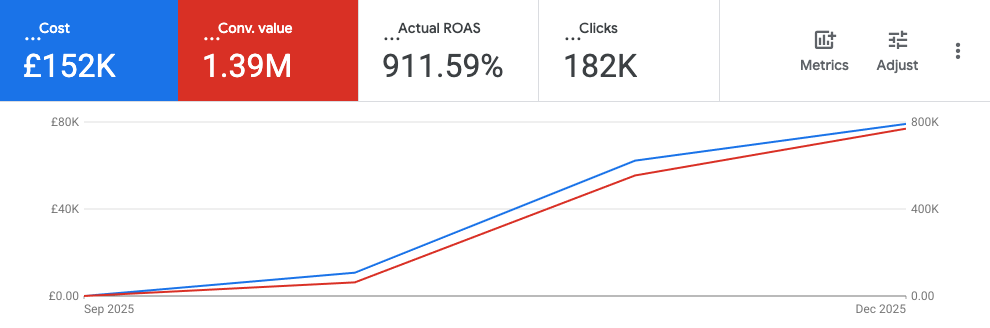
We scaled a client’s Shopify store from around $20K/month in Google Ads revenue to $800K/month in just two months.
One note before you read. This is not a magic framework you can copy and get the same outcome in any Shopify store. That does not exist. Every business is different.
This case is about the right mix of a strong product, good timing, a clear Google Ads for Shopify strategy, and fast hypothesis testing.
It won’t look identical for every business, but I’ll show you exactly what we did and why it worked.
About the Project
This was a Shopify store in the sports goods niche, selling home fitness equipment. They ship worldwide. Average AOV was around $75.
When we came in, Google Ads was already running, but it was only a brand campaign, and only for the US. The account was basically empty. There was no real historical data we could rely on.
That made the job harder, because Q4 was already around the corner and we could not be 100% sure we would make it work.
At that point the account was generating around £20K in sales with a strong ROAS, but that was expected. It was brand traffic only.
Shopify Google Ads Strategy and Account Structure
Before we talk about specific campaigns, I want to explain the thinking behind the Shopify Google Ads strategy. Because if you copy the “tactics” without the logic, you will most likely copy the wrong parts.
When we started, the account was basically a brand-only setup for the US. It looked profitable, but it was not giving us the one thing we needed most: proof that we can scale beyond people who already know the brand.
How We Defined the Strategy
The first thing we did was stop looking at the £20K brand revenue as a “signal of success”. Brand campaigns often look amazing on paper. That is normal. The real question was simple: can we create new demand at scale, fast, with almost no historical data, right before Q4?
1) No search intent
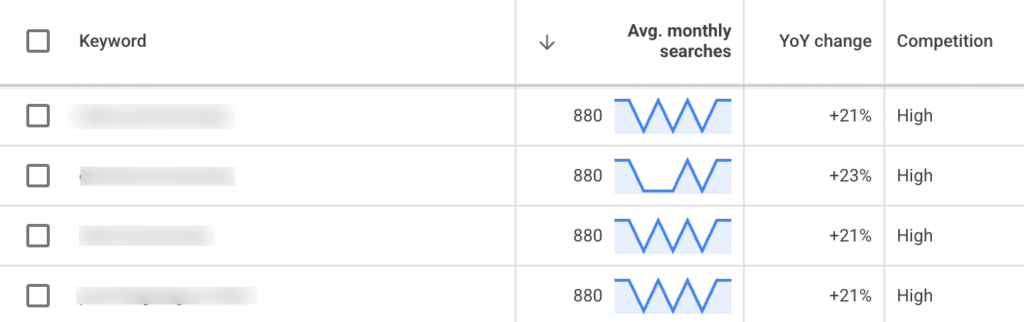
Search demand for this product was very limited. People were not searching for it directly. Most of them did not even know this product exists.
So we knew right away: if we just run a standard Google Ads setup and try to “bring relevant traffic”, it won’t move the needle. There simply isn’t enough direct intent.
We had to find two things instead:
- what similar keywords we can use
- which groups of people could be interested
In other words, our job was not only to capture demand. We first had to borrow demand from nearby intent, and only then scale.
2) Competition
Competition was almost non-existent. There were only a few sellers offering similar products, but much cheaper and clearly lower quality.
This also explained why search volume was so small. The category itself wasn’t developed. People don’t search for what they don’t know, and there were no strong brands pushing this product into the market.
But for us, this was not only a problem. It was also an opportunity.
We realized we don’t need to “beat” dozens of competitors in auctions. Our real task was different: create demand where there was none.
And this became the foundation of our Google Ads for Shopify strategy for this store.
3) The Product
Before building campaigns, we did a simple SWOT on the product. The goal was not to look smart. The goal was to understand what we can lean on, what can hurt us, and who we should not target from day one.
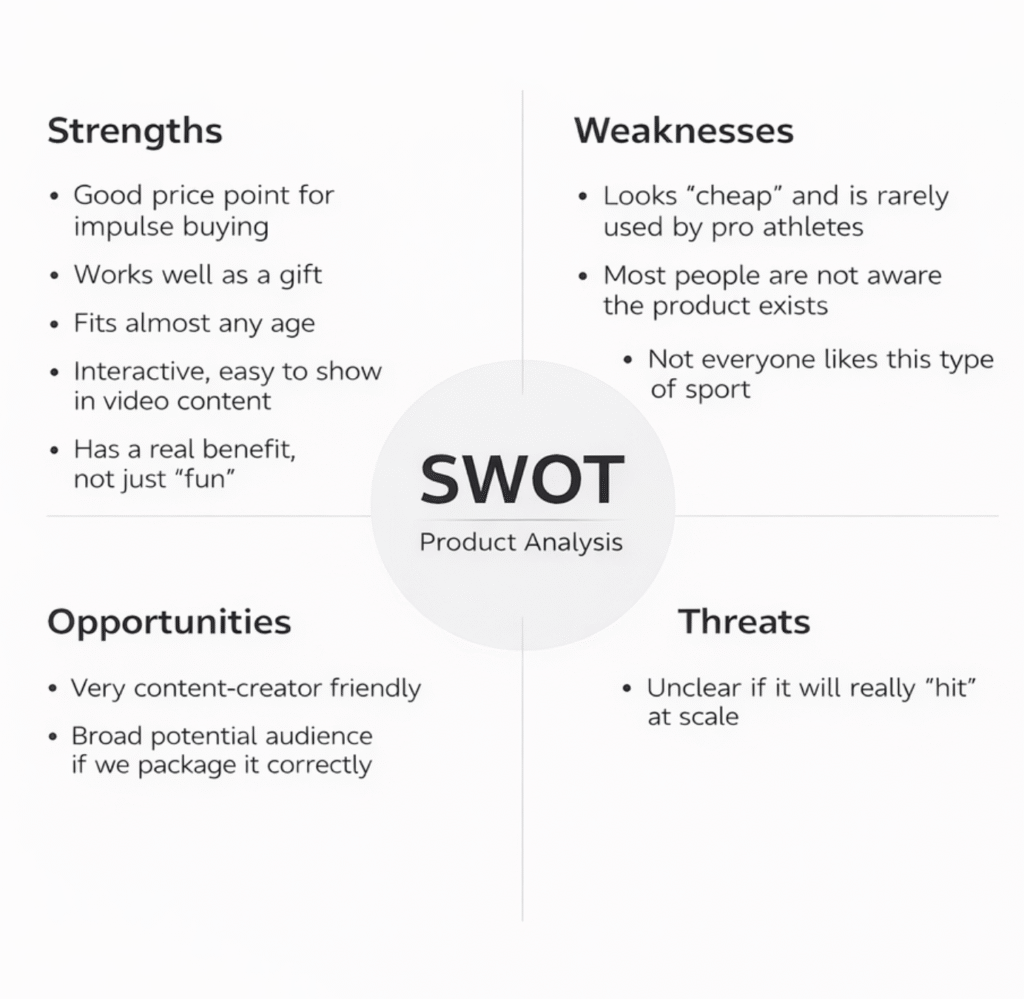
We were not dealing with a “high-intent” product where people already search the exact name and compare brands. Awareness was low, and search demand was limited. So a pure “capture demand” approach would not scale.
At the same time, the upside was strong: good price point, gift potential, broad age fit, and a product that is easy to show in short video. Competition was basically weak, which meant we didn’t need to win a brutal auction war. We needed to create demand and then catch it.
3) AOV around $75
With an AOV around $75, you don’t have much room for sloppy traffic.
So from day one we had to be strict with three things:
- CPC discipline
We didn’t chase volume just because it was available. If clicks became too expensive, we treated it as a signal that the traffic is not right for this product. Lower AOV means you can’t pay premium CPC for “nice looking” impressions. - CPA guardrails
We set a realistic cost-per-sale range and used it as a hard filter. If a segment couldn’t hit it after a fair test, we didn’t “give it more time”. We cut it and moved on. - Traffic quality over traffic quantity
At this price point, you don’t win by getting more clicks. You win by getting the right clicks. That’s why structure mattered so much: we needed to control where the budget goes, what search intent we buy, and which audiences we let in.
This is also why we focused on fast testing. With AOV $75, you can’t spend weeks “learning”. You either find angles that sell, or you stop burning budget.
Google Search Ads Strategy for Shopify
We separated non-brand Search into two campaigns: US and selected high-purchasing-power countries. We didn’t want “worldwide” targeting just for the sake of it. We only sent traffic where conversion potential was real.
Structure & Ads
We structured the Shopify Google Search campaigns around intent. Ad groups were split by core search themes, so each group had tight keyword clusters and truly relevant ad copy. This way, when someone searched for a specific problem or use case, they saw an ad that matched their wording, not a generic “one ad for everything” message.
Inside the ads, we pushed one main angle: quality. In a niche where most competitors looked cheap, we made it clear that this product was the premium option. Not “the best in the world”, just a better-built, higher-quality choice for people who want something that actually lasts.
Bidding Strategy
We used a portfolio Target ROAS bidding strategy with a Max CPC limit.
The account already had enough conversion data, so Target ROAS made sense as a starting point. We began with a 900% Target ROAS, but we couldn’t afford to let Google decide CPC freely. With this price point, the system can easily overpay for clicks.
So we kept the strategy on a leash with a Max CPC cap. As we started hitting the results we wanted, we scaled in a controlled way: we increased the Max CPC limit and reduced the Target ROAS to unlock more volume without losing efficiency.
Results
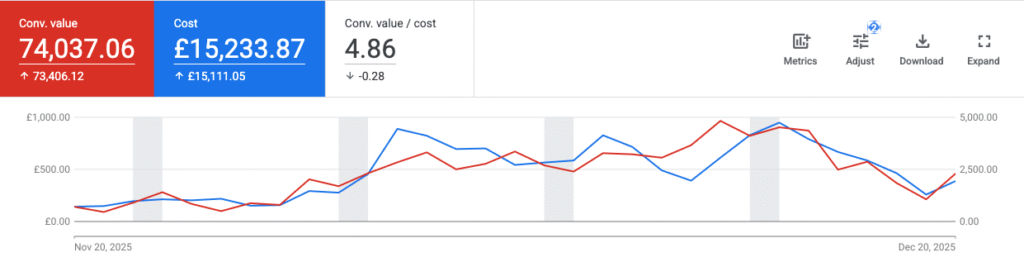
Non-brand Search was the channel we trusted the most. It’s predictable, and we built the keyword semantics to be as relevant as possible. The only problem was scale: demand was limited, so our job was to squeeze the maximum out of it.
And it worked. After short time of optimization, Search performance was strong and the results fully matched our expectations.
Google Shopping Ads Strategy for Shopify
Google Shopping was the core scaling channel for this Shopify store. Search helped us capture the limited intent that existed, but Shopping is where we could expand reach through the product feed and let the system find buyers faster. In this section I’ll break down how we set up the feed, how we structured Shopping campaigns, and what changes actually moved performance.
Campaign Structure
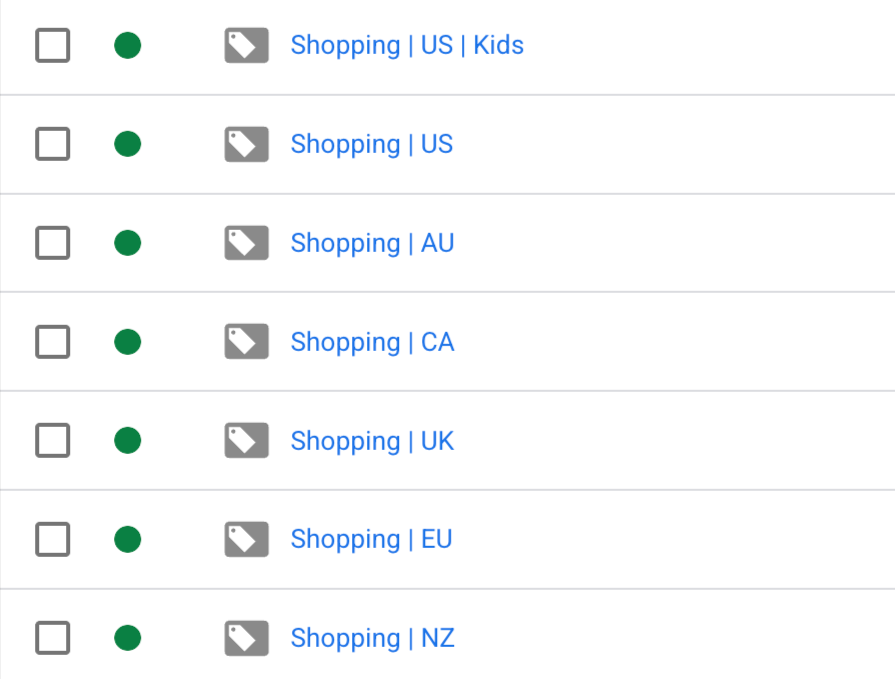
For Google Shopping, we didn’t run one “Worldwide” campaign and hope for the best. We split Shopping by country/region, because each market behaves differently. CPCs, conversion rates, competition, shipping expectations, and even returns can change a lot from US to UK to AU. If you keep everything in one bucket, you lose control fast and your best markets end up subsidizing the weak ones.
So we built separate Shopping campaigns for the US, CA, UK, EU, AU, and NZ
We quickly noticed something interesting in the data.
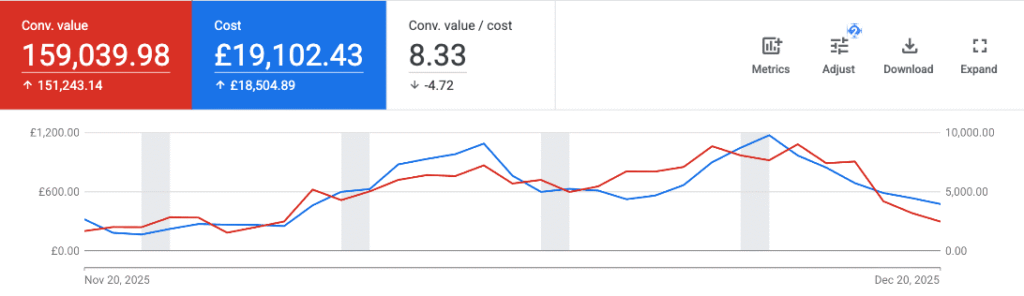
From the search terms and Shopping queries, it was clear that parents were actively buying this product for their kids. This was not a small pattern. It kept repeating.
So we didn’t just “mention kids” in ads and hope it helps. We built a separate US | Kids Shopping campaign and adjusted the feed to fit that audience. Different angles, different wording, and the right attributes so Google could match us to kid-related intent more consistently.
This test grew fast. Very fast.
It became the most successful campaign inside our Google Ads for Shopify strategy. And more importantly, it revealed our main audience: parents with kids around 6 to 12 years old.
Sales started coming in so aggressively that, honestly, we were shocked ourselves.
Feed & Bidding Strategy
We didn’t do anything “secret” with the product feed. We mostly followed Google’s standard recommendations and then made it practical. The main work was using real data from Search terms to understand how people describe the product, and then putting that language into product titles and descriptions. Not for SEO. For relevance and better matching inside Shopping.
The Kids campaign was different. The feed there was intentionally broader. The goal was to show up not only for the exact product name, but also for the kind of searches parents make when they look for kid-related items in similar categories. In other words, we adjusted the feed to match parent intent, not just product intent.
For bidding, we used the same approach as in Search: a portfolio Target ROAS strategy with a Max CPC limit. We started strict, kept CPC under control, and then loosened it step by step as performance proved itself.
Results:
Of course, what I described above is the “base” approach. There was a lot of ongoing optimization inside the campaigns, and it’s impossible to cover every single change in one article.
But the main point is simple: Shopping performed well across the board. Not just one lucky campaign. All markets were pulling their weight.
Later, we also separated brand traffic into a dedicated Shopping campaign, because it started to take a big share of spend and conversions. Once brand grows, you want it isolated, otherwise it becomes harder to see what is true incremental growth vs branded demand.
And here is the result of the Kids campaign I mentioned.
YouTube Ads for Shopify: Demand Creation at Scale
Search and Shopping helped us capture existing intent and scale what already worked. But because this category had low awareness, we also needed a channel that can create demand fast. That’s where YouTube came in. In this section I’ll explain Excella PPC approached YouTube Ads, what we tested, and how it supported the overall Google Ads for Shopify growth.
YouTube Ads Strategy
The SWOT analysis showed us one important thing: this product is perfect for content.
On top of that, Shopping campaigns helped us discover the best audience fit: parents with kids around 6–12 years old. It’s a huge audience, and it’s also very easy to target in Google Ads. So adding YouTube Ads was a very logical next step.
YouTube Shorts Ads
We chose YouTube Shorts ads because this product needed demand creation, not just demand capture.
It was also the best fit for the product itself. This is a very visual, interactive item. In a 10 to 20 second vertical video you can show the use case, show the kid reaction, and make the benefit obvious. That is much harder to do with a static image or a text ad.
Another reason we chose YouTube Shorts ads is content production.
For longer horizontal YouTube videos, you usually need professional creative: a solid script, good filming, lighting, editing, and often actors or locations. If you don’t do it well, the ad looks cheap and people skip in the first seconds. It’s expensive and slow to produce, especially when you need testing.
Shorts is different. Shorts-style content is much easier to produce, and you can create many variations fast: different hooks, different openings, different angles, different first 2 seconds. That speed matters when you’re trying to find what actually resonates.
And Shorts matches user behavior. People scroll and they are already in “watch mode”. If you catch attention early, they keep watching. That’s exactly what we needed: fast attention, fast learning, and enough volume to feed the rest of the funnel.
Why Shorts specifically, not long-form YouTube:
AOV reality: with around $75 AOV, we needed a format that can create a lot of interest without insane costs. Shorts was the safest way to do it.
Fast testing: we could test many hooks and angles quickly and see what people actually watch.
Mobile first reach: parents scroll on phones. Shorts is where attention is right now.
Efficient discovery: compared to other formats, Shorts often gives cheaper, larger reach, which matters when you need awareness.
Perfect for our funnel: Shorts introduced the product, then Shopping and Search picked up the warmer traffic and converted it.
Results
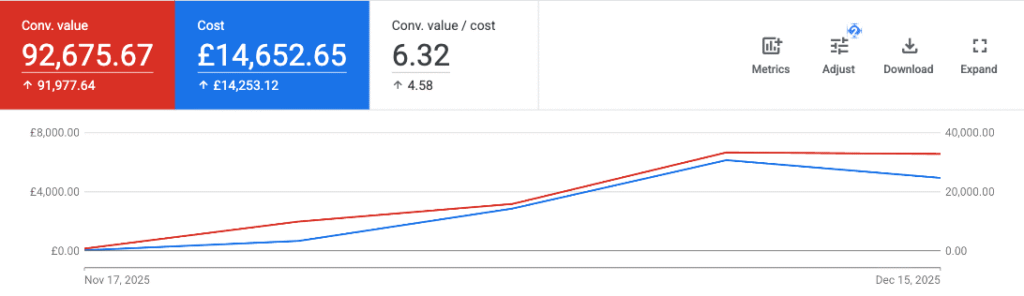
The results were strong from day one. Not “it improved after a month”. It started working immediately.
That early signal mattered more than any theory. It gave us confidence to scale budgets while Q4 was still open, not when it was already over. We didn’t need weeks of “learning” to justify spend.
Because Shorts was creating fresh demand at the top, Shopping and Search started converting warmer traffic faster. That combination is what allowed us to keep scaling YouTube Shorts ads through the rest of Q4 without losing control.
Lessons Learned and What’s Next
Test, Data First
Neither the owner nor we expected parents to be this interested in the product. If we didn’t run a small test, we would have missed the main opportunity and most of the profit.
This is why our Shopify marketing strategy is simple: test first, then decide. Not the other way around. In this case study, the “Kids” angle started as a small hypothesis. It became the strongest part of the Shopify Google Ads strategy.
If you run Google Ads for Shopify and you think you already understand your audience, you are probably missing something. Data will surprise you.
What We’re Scaling Next
Next, we are scaling in three directions inside our Google Ads for ecommerce system.
First, we will keep improving structure and expand non US countries in Google Search ads strategy for Shopify and Google Shopping ads for Shopify. We already see that there is demand outside the US. It just needs focus and clean execution by country.
Second, we will push harder on YouTube Shorts ads. More audiences. More creative angles. More variations. Shorts gave us fast demand creation, which is exactly what this category needed.
Third, we will test in stream YouTube ads with a professional horizontal video. Shorts is perfect for speed and volume. A strong long form video can add trust and sell the product differently.
If You’re a Shopify Owner Running Google Ads
Three practical takeaways from this Google Ads for Shopify case study:
- Separate brand early. Brand ROAS looks amazing in almost any account and it can hide what is actually growing.
- If search intent is limited, do not obsess over the perfect keyword list. Use Google Shopping and YouTube Shorts to create and capture demand together.
- Your best audience can be the one you did not plan for. The parent segment came from a test. It became the engine.
If you want to see more of our work, check our portfolio. Also, you might find our guide Ecommerce Trends 2026: Performance Marketing useful. And if you want to discuss your Shopify store, we can jump on a call and review your situation.
We also wrote a practical guide on how to choose a Google Ads agency, so you don’t waste money on the wrong team.