Google Ads for IV Therapy in 2026
Google Ads is still the fastest way to get high-intent IV Therapy leads because it captures people already looking for a solution. Not “discovering” you. Not scrolling. They’re searching: IV near me, mobile IV hydration, hangover IV, NAD+ infusion, IV drip clinic.
But most IV clinics run Google Ads like they’re selling a simple product.
IV therapy isn’t a simple product. It’s a trust purchase + often same-day intent + local decision. If your ads and landing page don’t feel credible in 3 seconds, people bounce. If your tracking is weak, Google “optimizes” you into cheap leads that never book. And if your offer is messy, you’ll pay premium CPCs for zero real patients.
Market size
According to Grand View Research, the IV hydration therapy market in North America was estimated at $1.6B in 2024 and is projected to grow at a 8.7% CAGR from 2025 to 2030
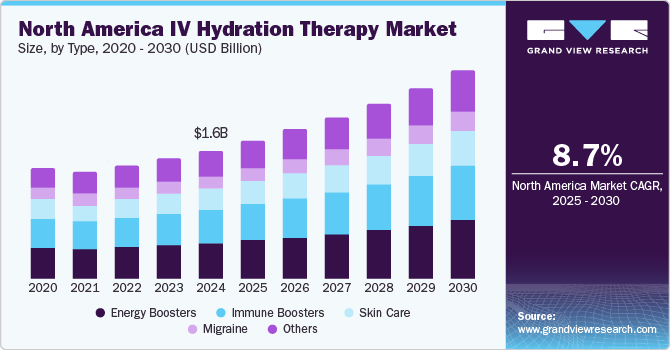
What’s driving this growth is exactly what you see in real life: people care more about proactive health, they’re shifting toward preventive wellness, and they want convenient, on-demand services (especially post-pandemic).
For clinics, this is good news and bad news. Demand is growing, but so is competition. More providers enter the market, ad costs go up, and “generic IV therapy ads” stop working. That’s why Google Ads for IV therapy in 2026 has to be built around intent + trust + conversion, not just keywords and budgets.
What’s different in 2026 (and why it matters)
Google keeps pushing automation harder. That can help you scale, or it can quietly burn budget if you don’t control inputs.
So the winning clinics do three things well:
– They train Google on real outcomes (booked appointments, not random leads).
– They match intent precisely (right keywords + negatives + tight messaging).
– They look trustworthy instantly (landing page and proof).
What you’ll get from this guide
You’ll learn how to build and optimize:
- A conversion-focused setup for IV therapy leads (calls, forms, bookings)
- Landing pages that convert without looking “salesy”
- Search campaigns that don’t drown in irrelevant traffic
- Performance Max that supports growth without destroying lead quality
- Tracking that tells you the truth (including offline conversion tracking)
If you’re starting from scratch, you’ll leave with a launch plan.
If you’re already spending, you’ll quickly see why your leads are expensive and why your conversion rate is stuck.
At Excella PPC, we’ve managed $1M+ in Google Ads spend for IV therapy clinics and mobile IV services across the United States. We know what actually drives booked appointments in this niche (and what just burns budget).
In this guide, we’ll share the exact approach we use so you can apply it to your IV therapy business.
IV Therapy Marketing: Target Audience & Decision Triggers
Most IV clinics talk about services. Patients think in outcomes. They don’t wake up wanting a “Myers cocktail.” They wake up with a problem:
“I feel awful. Fix this today.”
“I’m getting sick. I need to bounce back.”
“I’m flying tomorrow. I can’t afford to be dead.”
“I’m training. I want to perform.”
“I’ve tried everything. Maybe NAD+ helps.”
Your job in IV Therapy marketing is simple: match the message to the exact situation the person is in. If you don’t, Google Ads becomes expensive fast because you’re paying for clicks from people who aren’t sure you’re for them.
How patients actually choose an IV clinic
You’re not competing on “who has the best IV drip.” You’re competing on trust + convenience.
Here’s the typical decision path:
- They search on their phone.
- They open 2–4 options.
- They scan for safety, reviews, and clarity.
- They pick whoever feels legitimate and easy to book.
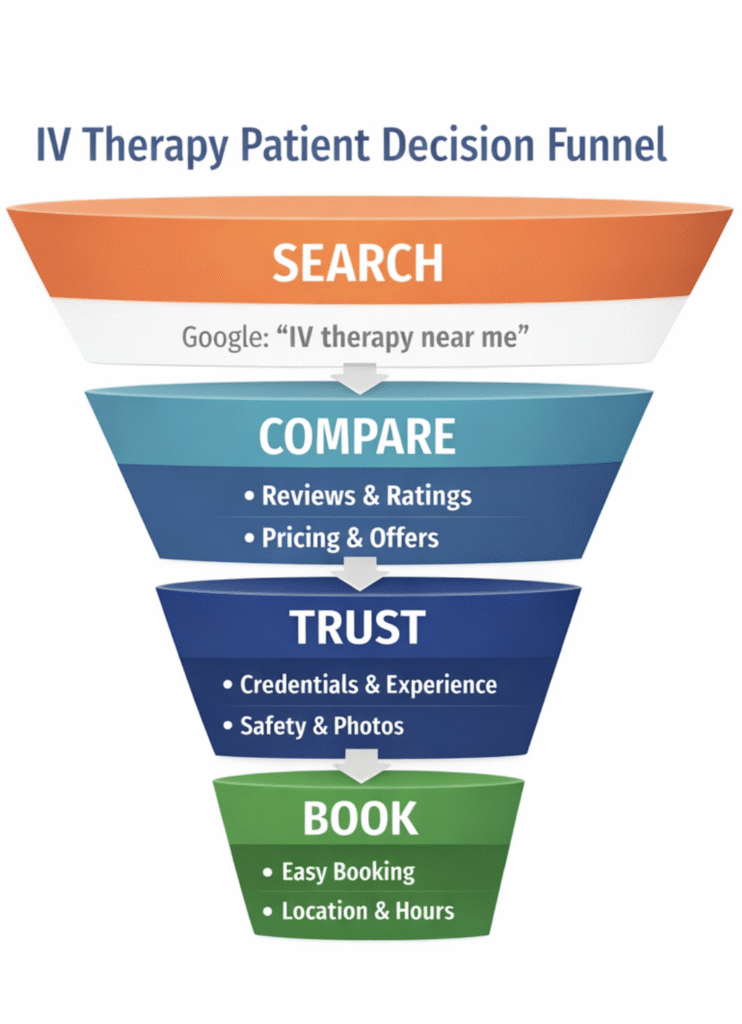
That’s it. They’re not analyzing your “formula.” They’re trying to avoid wasting time and money on something that feels questionable.
The trust triggers that move people from click to booking
These elements consistently increase conversion rate for IV Therapy ads:
- Real reviews (especially ones that mention the exact issue they’re searching for)
- Photos of the clinic and staff (not stock images)
- Credentials and medical oversight shown clearly
- Clear service area for mobile IV
- A simple explanation of the process (what happens after they book)
- Pricing transparency (full price, range, or “starting from”)
Mobile IV vs in-clinic: don’t mix the message
These are two different buying decisions.
Mobile IV is about:
– coverage area
– response time
– convenience
– trust (who is coming to my home?)
In-clinic is about:
– cleanliness and professionalism
– location and parking
– comfort
– reviews and atmosphere
Understanding these core principles is the foundation you should build your entire Google Ads strategy for IV therapy services on.
Landing Page for IV Therapy Ads
You can run perfect campaigns and still lose if the landing page is weak.
With IV Therapy ads, the click is expensive and the decision is emotional: people feel bad, they’re skeptical, and they want a safe choice fast. Your landing page has one job: turn “I’m not sure” into “I’m booking.”
Message match comes first (or nothing else matters)
If someone searches hangover IV near me and lands on a generic “IV hydration services” page with 12 drips, you already lost.
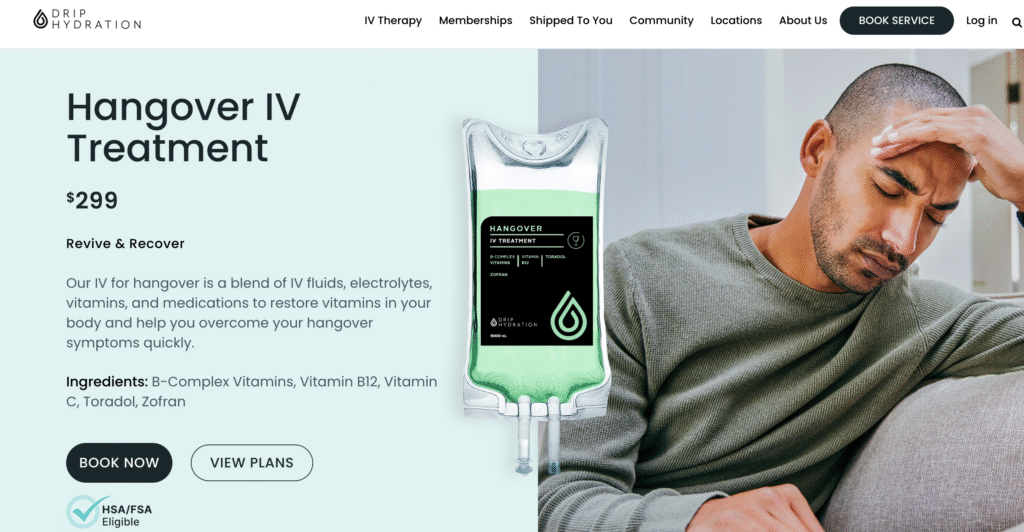
Create pages by intent:
- Hangover and dehydration
- Immunity and wellness
- Energy and performance
- NAD+ / specialty
- Mobile IV (separate page, separate logic)
Above the fold: what must be visible in 3 seconds (to make it perfect)
Your top section should answer these questions instantly:
- What is it? IV Hydration Therapy (clinic or mobile)
- Is it for me? Hangover relief, hydration, recovery, wellness, etc (match the page intent)
- Can I get it today? Same-day available (only if true)
- Is it legit? Licensed staff, medical oversight, real clinic photos
- Is it in my city? In-clinic: Visit us at [City]. Mobile IV: We serve
- What do I do next? Call / Book online (one primary CTA)
Offer strategy
Use this structure:
- Hero offer (one main option, the most common choice)
- 2–3 supporting options (simple labels, not chemistry)
- Add-ons (optional)
- Not sure? mini consult path
Example:
- Hero: “Hydration + Recovery IV”
- Options: “Hangover Relief”, “Immunity Support”, “Energy Boost”
- Add-ons: B12, Glutathione, etc (if relevant)
- Not sure: “Tell us your goal, we’ll recommend the right drip”
This reduces confusion and improves lead quality.
Trust section (this is where IV Therapy marketing wins)
Include:
- Real clinic photos and staff (not stock)
- Credentials and medical oversight (simple, visible)
- Reviews (preferably filtered by the problem, hangover, recovery, wellness)
- Safety and process (what happens after booking)
- Clear location info (address, parking, hours)
- For mobile IV: coverage area + who comes to the home
People don’t read. They scan for signals.
Mobile IV landing page rules (separate page, separate content)
If you run mobile IV ads, your page must answer these immediately:
- Where you go (map or list of cities)
- How fast you can arrive (realistic)
- Minimum price / travel fee (or clear pricing logic)
- Who comes (licensed nurse, medical oversight)
- How booking works (call, text, online)
Mobile IV is convenience-first, but trust still decides the sale. Your Google Ads can only perform as well as the page behind the click. In IV therapy, the landing page is not “support.” It’s the main conversion engine.
Conversion Tracking for IV Therapy Leads
If tracking is wrong, Google Ads will optimize for the wrong thing. In IV therapy that usually means spam calls, accidental taps, and low intent forms.
Your tracking should answer one question: which clicks turned into booked appointments (or at least qualified calls).
What to track
Set up conversion actions for:
- Calls from ads (call assets / call ads)
- Calls from website (click to call + tracked number)
- Calls from Google Business Profile (Maps / local actions)
- Form submissions (real success, not “button click”)
- Bookings (best signal if you can track it)
Google Forwarding Number (GFN) is mandatory for call attribution
Google call reporting runs on Google Forwarding Numbers. That’s how Google ties calls back to the keyword, ad, campaign, and call duration.
What to do:
- Turn on call reporting
- Count calls as conversions with a minimum call length (ex: 30–60s) so you don’t optimize for junk calls
- Use call assets properly (Search only)
CallRail setup (do it clean or you’ll destroy attribution)
CallRail is great for IV therapy, but only if you separate the sources.
1) Website calls (CallRail DNI)
Use Dynamic Number Insertion (DNI) so CallRail swaps numbers based on traffic source and you can attribute calls correctly.
Make sure the swapped number appears in:
– header phone number
– sticky mobile call button
– contact section
2) Calls from Google Ads (call assets)
For calls directly from the ad, let Google handle it via GFN call reporting. That’s the cleanest way to keep keyword-level attribution and bidding signals.
3) Google Business Profile (GBP / Maps) calls
GBP calls are huge for IV therapy. Track them separately so they don’t get mixed with paid calls.
Form leads: track the real submit, not the click
Only fire the conversion when the form is successfully submitted (thank-you page or success event).
The upgrade that changes everything: track booked appointments (offline)
Google supports importing offline outcomes (using GCLID, or enhanced conversions for leads).
Once Google sees what a real IV therapy lead looks like, bidding and lead quality usually improve over time.
Google Ads Campaign Types for IV Therapy
There are many ways to spend money in Google Ads. Only a few consistently produce IV therapy leads you can actually book.
The right campaign mix depends on your model (in-clinic vs mobile IV), your city, and your capacity to answer calls fast. But the order below works in most markets.
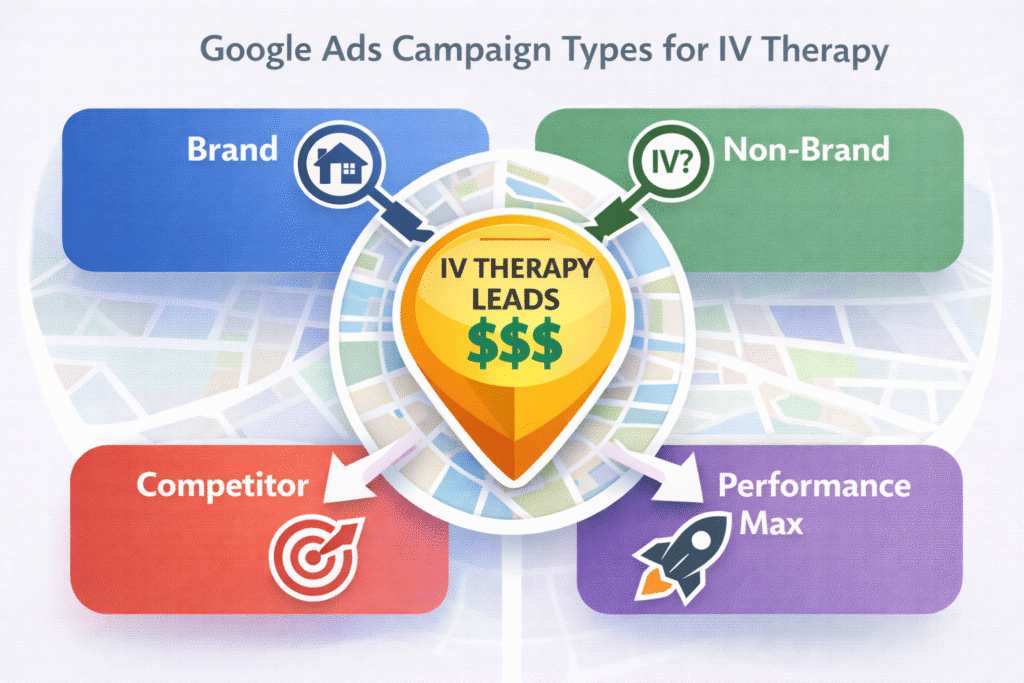
Brand Search (always)
This is the cheapest, highest-quality traffic you’ll ever get.
Why it matters: if you don’t run brand, competitors can take that traffic. Also, brand performance is your baseline “trust thermometer.”
Non-brand Search (your main lead engine)
This is the core of Google Ads for IV therapy because it targets direct intent.
Examples of intent buckets:
- “IV hydration near me”
- “mobile IV therapy”
- “hangover IV”
- “IV drip clinic”
- “NAD+ infusion near me” (separate bucket, separate messaging)
Key rule: build separate ad groups (or campaigns) by intent. Don’t mix hangover with NAD+. Different mindset, different price sensitivity, different conversion path.
Competitor Search (optional, can be profitable)
This is not for everyone. Done wrong, it’s expensive and messy.
Use it when:
- competitors are weak (bad reviews, bad pages, slow booking)
- you have strong trust proof and better booking experience
- you can afford higher CPCs
Avoid it when:
- you’re new with limited reviews
- you don’t have a strong differentiator
- your offer/landing page isn’t tight
Competitor traffic is “comparison mode.” Your page must answer: why you over them.
Performance Max (good accelerator, not a “start here” campaign)
PMax can help expand volume, especially if you already have conversions flowing. But it can also bring low-quality leads if you launch it too early or too broad.
Performance Max can also help you show up more often across Google’s local surfaces (including Maps placements) for your priority IV therapy searches, especially when your location signals and landing pages are aligned with the services you want to push. So this campaign type work better for in-clinic offers.
Next section we’ll break down the money-maker in detail: Search Ads for IV Therapy.
Search Ads for IV Therapy
Search is where the highest intent IV therapy leads come from. It’s also where most clinics waste money, because they go too broad, don’t control search terms, and send everyone to one generic page.
The goal is simple: match intent → show a credible message → send to the right page → track booked outcomes.
1) Build campaigns/ad groups by intent
Mobile IV should always be its own separate campaign. The intent, geography, ad messaging, and landing page logic are different from in-clinic traffic, and mixing them usually inflates CPL and lowers booking rate.
Split campaigns into separate ad groups like this:
- IV Hydration Near Me (core)
- Mobile IV Therapy
- Hangover IV
- Recovery / Wellness / Immunity
- NAD+ / specialty
Here’s part of the campaign structure we used for one of our IV therapy client:
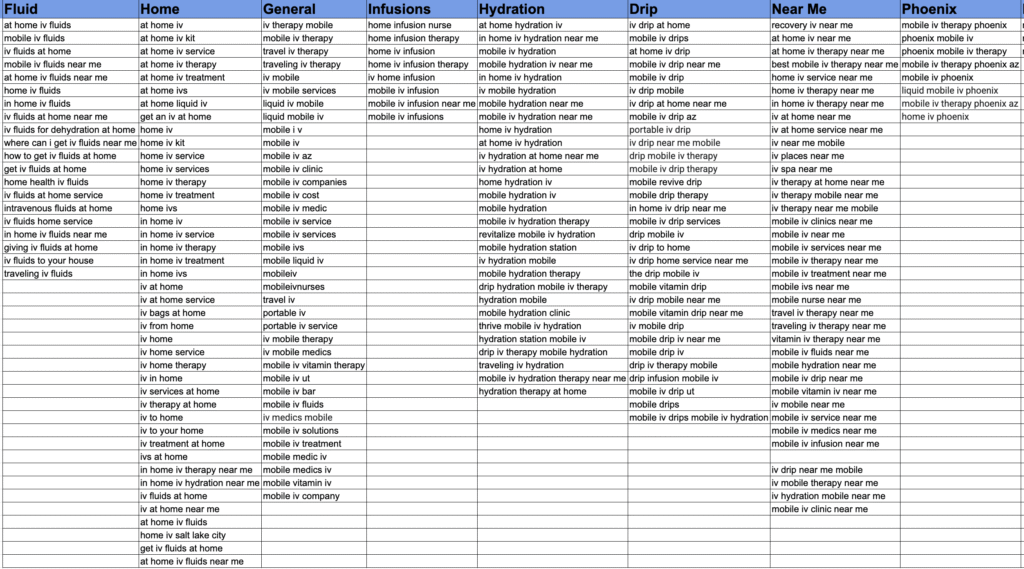
Why this matters: every intent has different psychology, different price sensitivity, and different conversion path. If you mix them, your ads become generic, CTR drops, CPC rises, and conversion rate dies.
2) The negative keywords that save you the most money
You want to block:
- jobs / training intent (people looking for work or certifications)
- DIY / supplies intent (bags, kits, saline, IV equipment)
- medical education intent (definitions, studies, nursing school)
- hospitals / ER intent if you’re not competing there
- unrelated “IV” meanings (varies by market)
Also build negatives based on your business model:
- if you don’t do mobile IV → negative “mobile”, “home”, “hotel”
- if you don’t do NAD+ → negative “nad”
- if you don’t do hangover → negative “hangover”
Most clinics could cut wasted spend 20–40% just by being serious about search terms and negatives.
3) Ad copy that converts
IV therapy is a trust purchase. Your ad should feel safe and clear, not hypey.
Good ad angles:
- Same-day availability (only if true)
- Licensed staff / medical oversight
- Mobile IV to home/hotel (if offered)
- Transparent pricing (“starting from” works well)
- Strong reviews (“4.9★ from X reviews” if accurate)
Avoid:
- miracle claims
- guaranteed results
- aggressive “cure” language
- medical promises you can’t support
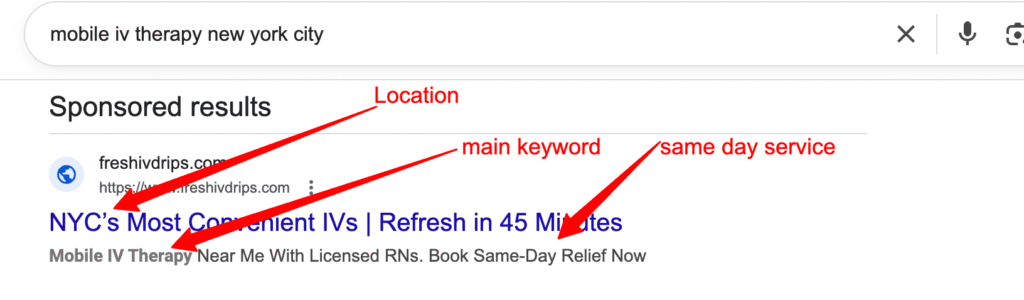
Simple wins:
- mirror the keyword in the headline
- include the city/service area
- make the next step obvious (Book / Call)
4) Use assets/extensions like a conversion booster
For IV therapy ads, assets aren’t decoration. They’re proof.
Prioritize:
- Call asset (if you answer fast)
- Location asset (especially in-clinic)
- Sitelinks (Hangover IV, Mobile IV, Pricing, Reviews, Book)
- Structured snippets (“Services: Hydration, Recovery, Immunity, NAD+”)
- Callouts (“Same-day”, “Licensed staff”, “Transparent pricing”)
7) Bidding strategy for iv therapy ads
Good starting point:
- Manual CPC (so you can increase bids step by step)
- after you have stable conversion volume → test tCPA with max CPC limit.
Competitor ads (IV Therapy)
In competitor campaigns, we’ve consistently seen better results after switching from “traditional competitor search” to AI Max at the ad group level.
The difference is simple: classic competitor campaigns are usually too rigid. You target a few competitor keywords, write a few ads, and hope intent is clean. With AI Max, you can capture the same competitor intent but with broader, smarter matching and better messaging alignment, while still keeping control.
Why this works
1) Better coverage of real competitor intent
People rarely search the competitor name perfectly. They search variations, comparisons, misspellings, and “near me” combinations. AI Max catches more of this without you building a giant keyword list.
2) Better ad relevance without writing 50 ads
Competitor traffic is in “comparison mode.” AI Max tends to match ad messaging to what the user actually meant, which improves CTR and landing page alignment.
3) Cleaner lead quality when you add guardrails
Brand lists and URL signals help keep the system from expanding into low intent terms.
What we see in performance
In multiple tests, this approach produced lower CPA versus traditional competitor search setups, mainly because:
- wasted clicks dropped
- more searches matched the right message
- conversion rate improved without needing a massive keyword buildout
Performance Max for IV Therapy Ads
We recommend Performance Max for in-clinic IV therapy ads only.
For in-clinic, PMax can work well as a scale layer once you already have solid Search performance and clean conversion tracking.
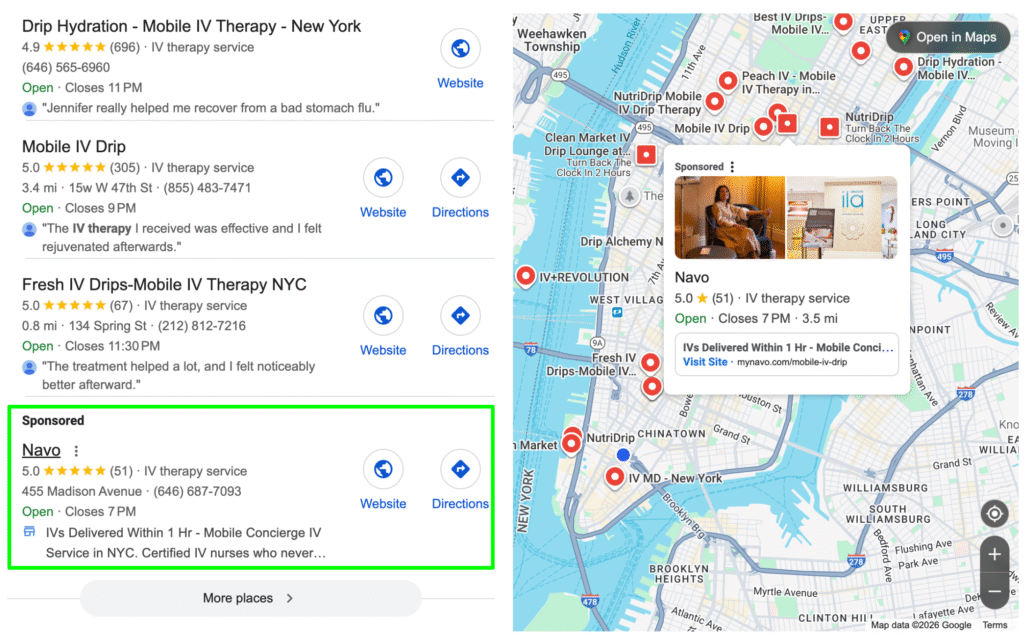
How we set up Performance Max for IV therapy (simple and controlled)
1) Use only Search themes as signals.
Keep it focused. Use search themes based on real high-intent services, not broad wellness topics.
2) Link your IV Clinic Google Business Profile
When GBP is connected, PMax can use location context and local surfaces more effectively for in-clinic intent.
3) Build asset groups around search theme relevance
Do not create one asset group for everything. Create asset groups that match your intent themes and landing pages, for example:
4) Tight radius targeting around IV Clinic
For in-clinic IV therapy, radius targeting is one of the simplest ways to improve CPA.
We typically start with a tight radius (up to ~5 miles) around the clinic and expand only if lead quality stays strong.
Why: most people won’t drive far for an IV drip unless they already trust you or you’re in a low-competition area. Tight radius reduces wasted spend fast.
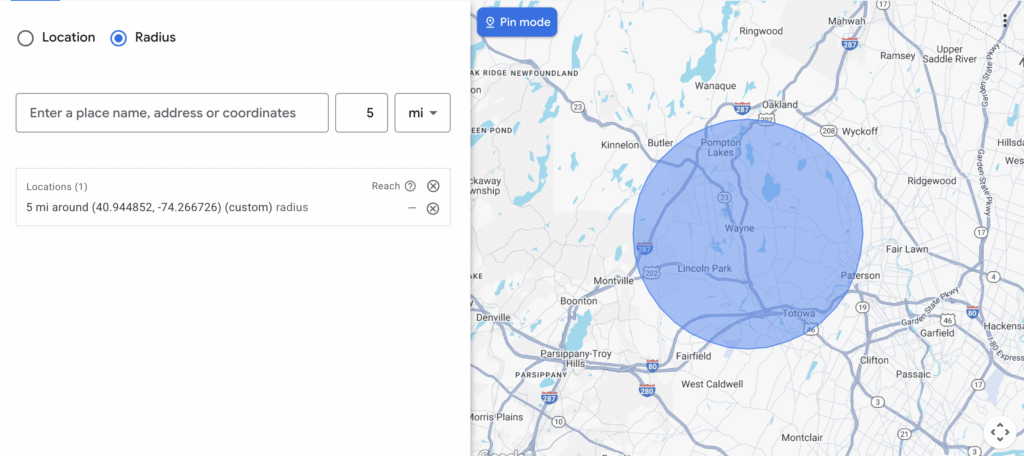
Use PMax to increase local visibility and volume for in-clinic IV therapy, but only after your Search foundation is working. Keep it tight: search themes only, GBP linked, asset groups aligned with intent, and radius targeting that matches how far patients realistically travel.
Conclusion
Google Ads can be one of the most predictable channels for IV therapy leads, but only if you treat it like a system, not a set of campaigns.
In 2026, the clinics that win aren’t the ones with the biggest budgets. They’re the ones that do the basics better than everyone else: they understand intent, they build landing pages that feel credible fast, they build a clean structure, and they track outcomes that actually matter.
If you want help applying this to your clinic, Excella PPC works with IV therapy clinics and mobile IV services across the U.S. We’ll review your current setup and tell you what’s limiting performance, what to fix first, and what it will realistically take to scale.
We wrote a practical guide on how to choose a Google Ads agency, so you don’t waste money on the wrong team.
Want us to review your Google Ads strategy for IV therapy services? Contact our Google Ads agency today.